
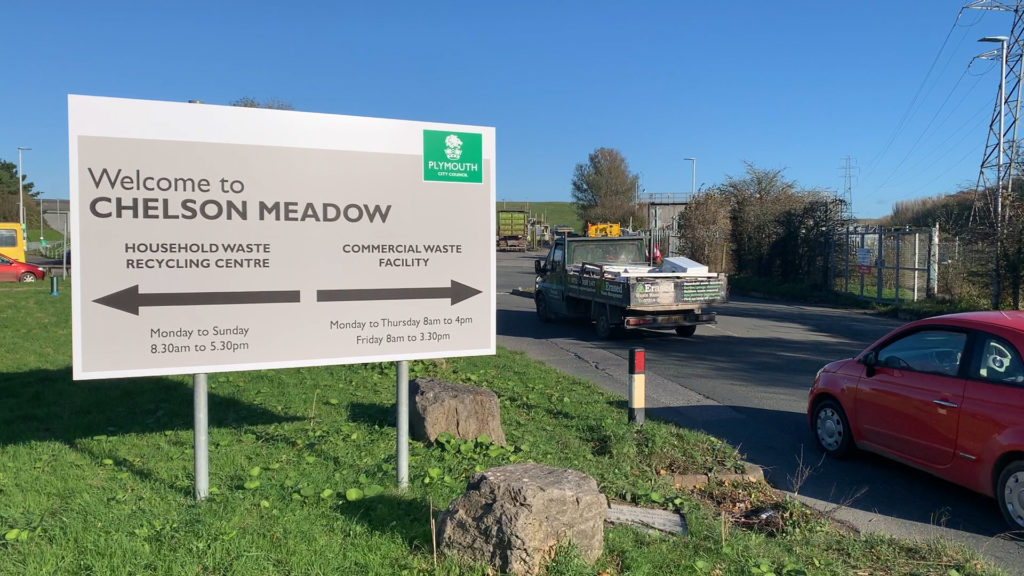
Most Plymouth homeowners have had the same thought at some point.
You’ve finished clearing the garage, ripped out an old bathroom or finally tackled the garden that’s been bothering you for years. There’s a sizeable pile of waste sitting on the driveway and one seemingly obvious solution.
Take it to the tip.
On paper, it sounds straightforward. Load up the car, drive to your local Household Waste Recycling Centre (HWRC) and unload everything in one trip.
In reality, it often isn’t that simple.
Every week, people arrive at recycling centres only to discover there are rules they weren’t aware of. Maybe they’ve brought the wrong vehicle, forgotten proof of address or loaded materials that can’t be disposed of together.
None of these regulations are particularly unreasonable, but they can quickly turn what was supposed to be a one-hour job into a frustrating day of unloading, repacking and rearranging plans.
Understanding the Plymouth recycling centre rules before you leave home can save a significant amount of time, effort and stress.
The biggest misconception is that recycling centres operate like giant bins
Many people understandably assume a Household Waste Recycling Centre works as a place where almost anything can be taken, provided it comes from your home.
That isn’t really how they operate.
Recycling centres are highly regulated facilities designed to separate and process different waste streams safely and efficiently. Certain materials need segregating, some items have quantity restrictions, and others may require additional checks before being accepted.
The challenge is that most homeowners only use these facilities occasionally. Unless you’ve recently completed a renovation or house clearance, it’s easy to forget the rules between visits.
Then, when you do need them, you’re suddenly trying to navigate regulations while sitting in a queue with a car full of waste.
DIY projects create most of the confusion
Over the past few years, DIY renovations have become one of the biggest sources of confusion at recycling centres.
Small projects quickly create large volumes of mixed waste. A bathroom renovation, for example, rarely produces one simple waste stream.
Instead, you could end up with old tiles, plasterboard, timber, packaging, metal fittings and broken ceramics all piled together.
The problem is that many of these materials need separating before disposal.
If everything is thrown into the back of a car or van without organisation, unloading becomes far more complicated once you arrive.
This is often the point homeowners realise they underestimated the scale of the project in the first place.
For larger renovation jobs, skip hire or professional waste removal services can sometimes become the simpler option, particularly when waste is being generated continuously over several days or weeks.
Proof of address is one of the easiest things to forget
This catches people out far more often than you might expect.
Household Waste Recycling Centres are designed for local residents, which means many facilities require proof that you live within the area.
This could be:
- A driving licence
- A recent council tax bill
- A utility bill
It sounds simple enough, but it’s surprisingly common for people to jump in the car and forget they need to prove where they live.
The result is an unnecessary wasted journey.
Before visiting any local recycling facility, it’s always worth checking the latest requirements beforehand, as policies can occasionally change.
Vans, trailers and larger vehicles often have additional restrictions
This is another area where people run into problems.
Many homeowners assume hiring a van automatically makes life easier because they can complete the job in one trip.
Sometimes the opposite happens.
Vehicle restrictions exist to prevent commercial misuse of household recycling centres, which means certain vehicle types may require permits or additional approval before entry.
This is particularly important if you’re undertaking:
- A large garden clearance
- A kitchen renovation
- A garage clear-out
- A small house clearance
If you’ve already hired a van, loaded everything up and then discover you can’t enter without prior permission, it creates a frustrating situation.
For larger projects, this is often where professional waste removal services become more efficient because they remove the logistical burden entirely.
Plasterboard continues to catch homeowners out
Plasterboard is one of the most misunderstood waste materials in the UK.
People naturally assume it can be thrown away alongside rubble, timber or general renovation debris. Unfortunately, it usually requires separate handling.
This is because plasterboard contains gypsum, which has specific disposal regulations designed to reduce environmental impact.
If you’re renovating a bathroom, converting a garage or updating internal walls, it’s worth planning ahead before loading plasterboard into the same pile as everything else.
This is one of the reasons many homeowners choose skip hire services for larger projects, as reputable providers can advise on waste segregation requirements before collection.
The queue is often longer than the actual unloading
This isn’t a regulation, but it’s a reality that catches people out during busy periods.
Weekends, bank holidays and sunny afternoons can become particularly busy across recycling centres.
Everyone has the same idea at exactly the same time.
A garage clear-out turns into a two-hour round trip, and suddenly what felt like a quick errand has consumed half the day.
This becomes especially frustrating if you’ve underestimated how much waste you have and realise one trip won’t be enough.
Multiple journeys don’t just cost time either. They add fuel expenses, additional wear on your vehicle and more physical effort than most people anticipate.
House clearances quickly outgrow recycling centre trips
Recycling centres work extremely well for smaller amounts of household waste.
However, once you’re dealing with an entire property, things change very quickly.
House clearances often involve multiple categories of waste spread across several rooms, lofts, garages and gardens.
The logistics alone become difficult.
Moving furniture, sorting belongings and repeatedly travelling backwards and forwards to recycling centres can turn into a project that lasts several days.
This is often why homeowners switch from a DIY approach to professional house clearance services midway through the process.
Not because they can’t physically do it themselves, but because the time commitment becomes far greater than initially expected.
Sometimes the cheapest option isn’t actually the cheapest
It’s natural to think taking waste to a recycling centre will always be the most affordable solution.
In some cases, that’s absolutely true.
But once multiple trips are involved, the equation changes.
Fuel costs, van hire, parking considerations, queue times and physical labour all add up surprisingly quickly.
For larger projects, there can be a tipping point where professional waste removal or skip hire becomes the more practical and cost-effective option.
This is particularly true for renovations, large garden projects or full property clearances.
The important thing is choosing the right solution for the amount of waste you actually have, not the amount you initially thought you’d generate.
Knowing when a recycling centre stops being the right answer
Household recycling centres remain an excellent resource for Plymouth residents.
But they aren’t designed to solve every waste problem.
Generally speaking, they work best when:
- The waste volume is relatively small.
- You can comfortably transport everything yourself.
- Materials are already separated.
- Access and time aren’t major issues.
- Once projects become larger, more complex or time-sensitive, alternative solutions often become more efficient.
Professional waste removal services, house clearance companies and skip hire providers exist because there comes a point where convenience, speed and practicality outweigh the effort of doing everything yourself.
Most of the Plymouth recycling centre rules that catch people out aren’t hidden at all. They simply aren’t things we think about until we’re already halfway through a project.
By that stage, waste has piled up, deadlines are looming and frustration starts to build.
Spending a few minutes checking requirements before visiting can save a significant amount of time and hassle.
And if your project is bigger than originally planned, don’t assume a recycling centre is your only option.
Sometimes a skip hire service, professional waste removal team or house clearance company is simply a better fit for the amount of waste you’re dealing with.
Because ultimately, the goal isn’t just to get rid of rubbish.
It’s to finish the project properly without turning waste disposal into another job entirely.